Project Details
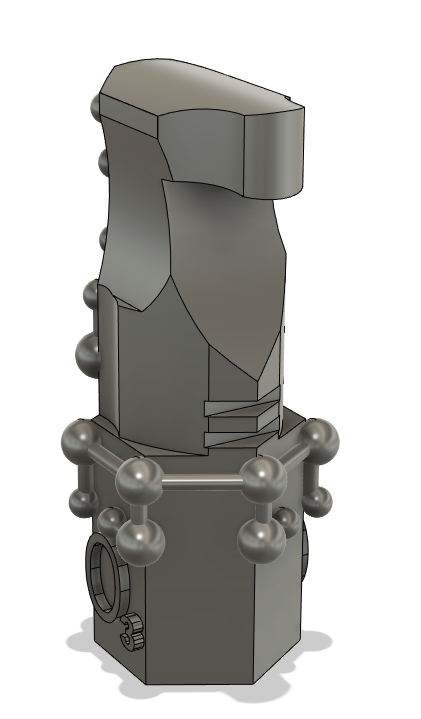
Knight; Adrenaline
CAD: Equations are important when drafting chess pieces since the customer requirement of the “feel” of the piece is paramount to the success
of the chess set. Equations keep the ratio between the width and the height correct. It also allows changes to be made quickly, which is important for rapid prototyping.
Design For Manufacturing: The knight piece was originally designed to be milled from a block of extruded recycled plastic and so was designed to
be as close to the width of the plastic block as possible to minimize waisted material and processing time. This piece did not need to be altered for 3D printing.
Design: I incorporated a ball and stick visualization to the Adrenaline molecule. Since Adrenaline has a long line of carbon and hydrogen, it
makes for a good horses mane. Using it as such allowed me to keep the recognizable look of a knight, while incorporating Adrenaline into the piece.
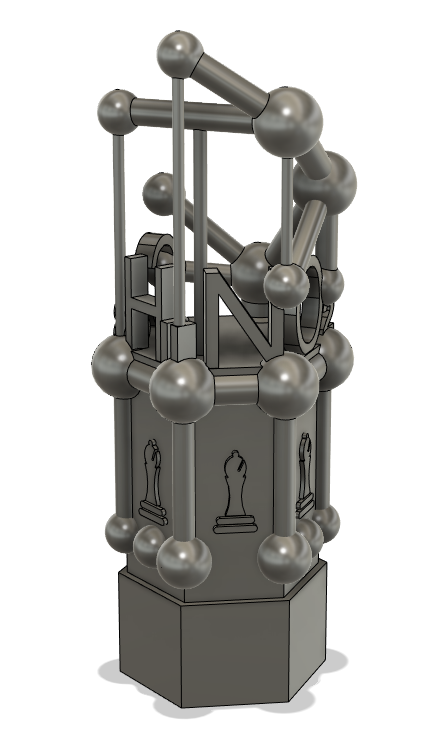
Bishop; Dopamine
CAD: The use of patterns, mirroring, and sketch path sweeps made the bishop significantly easier to work with.
Design For Manufacturing: Designing the bishop to be milled encouraged a traditional bishop design. This is because a more traditional
design waists less time and material. When designing the part to be 3D printed I added support into the design. This is more efficient than support generated by most slicers.
Design: The milled design for the bishop is similar to the knight as it takes a classic design and incorporates the molecular structure
of dopamine around a recognizable form. Designing for additive manufacturing allowed a design that highlights the molecular structure while also being recognizable as a bishop.
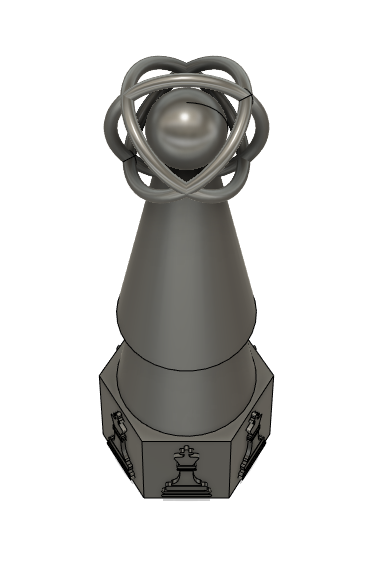
King; Atomic Symbol
CAD: The relationship between the width and the height was kept consistent with other pieces though the use of equations.
The traditional king shape was made using an imported picture along with a rotational pattern. The circles around the center were made with a sweep.
Design For Manufacturing: Original design worked for both milling and 3D printing. When milled, the center sphere would be larger
as the mill could only reach so far in. When 3D printed the proportions were designed to not need supports when building the outside layers or on the center sphere.
Design: The king was made to resemble the atom symbol when viewed from above at an angle (Left). This is designed for the angle at which
a person would see the king when playing a game of chess.
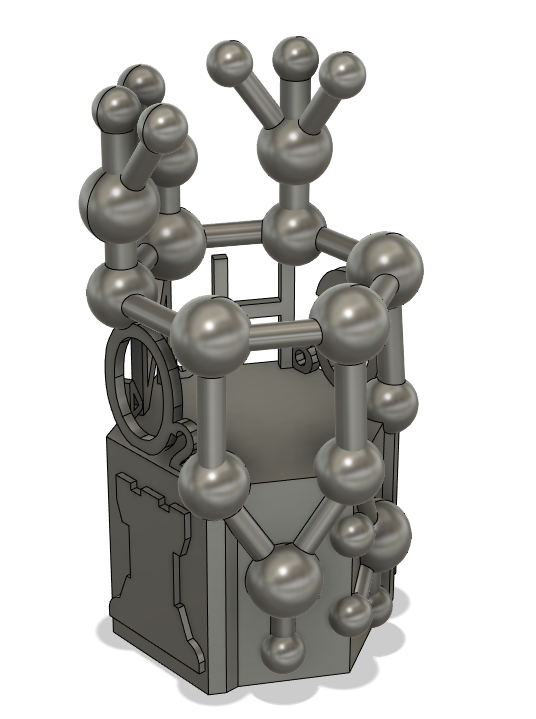
Rook; Caffeine
CAD: The crown of the rook was quickly done by utilizing mirroring. The body of the rook took more time due to the specifics of Caffeine.
Design For Manufacturing: The only difference between the rook design to be milled and the design to be 3D printed is the amount of
material in the upper half of the piece. When milling the top would be completely filled in, while 3D printing allows more empty space in the crown.
Design: Caffeine was an ideal candidate for the rook as it has a strong symmetric and geometric center that makes for a recognizable crown.
I designed the rest of the rook around the top crown formed by the main body of the molecule.
Knight; Adrenaline
CAD: Equations are important when drafting chess pieces since the customer requirement of the “feel” of the piece is paramount to the success
of the chess set. Equations keep the ratio between the width and the height correct. It also allows changes to be made quickly, which is important for rapid prototyping.
Design For Manufacturing: The knight piece was originally designed to be milled from a block of extruded recycled plastic and so was designed to
be as close to the width of the plastic block as possible to minimize waisted material and processing time. This piece did not need to be altered for 3D printing.
Design: I incorporated a ball and stick visualization to the Adrenaline molecule. Since Adrenaline has a long line of carbon and hydrogen, it
makes for a good horses mane. Using it as such allowed me to keep the recognizable look of a knight, while incorporating Adrenaline into the piece.
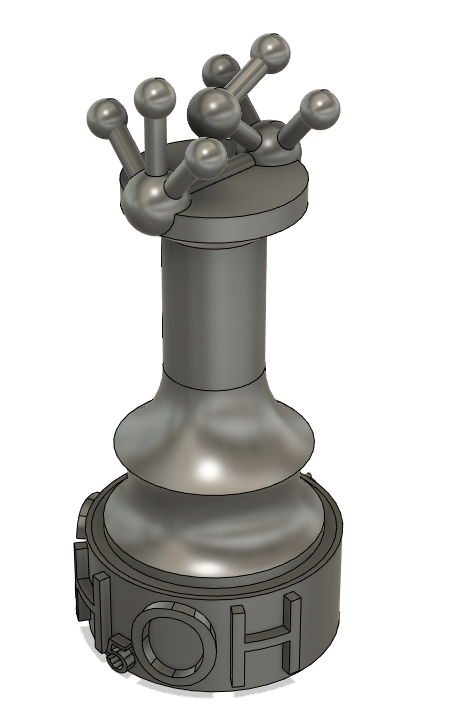
Queen; Ethanol
CAD: Ethanol forms the crown of queen, so the body of the queen can remain as close to a traditional queen as possible. The body was made with a
simple scetch and revolve, which formed a platform for the crown. An ethanol crown was then made with spheres, tubes and mirrors.
Design For Manufacturing: Similar to the rook, the milled and 3D printed versions are the same save there is more material left over after the
milling process than when the piece is 3D printed.
Design: Traditional chess queens are easily identified from their general size and outline. Keeping all of that consistent allowed the queen
to be both regonoizable and distinct.
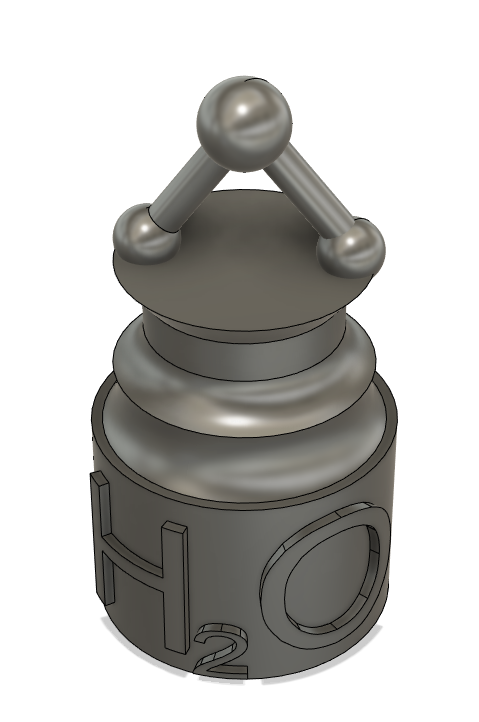
Pawn; Water
CAD: Water, similar to ethanol forms the top crown of the pawn. This made for the body of the pawn to be designed by a scetch and a revolve.
The crown of a water molecule was made by creating spheres for hydrogen and oxygen to then create a reference plane from one to the other and use that plane
to create a line that would allow a pipe to be made. This was mirrored across.
Design For Manufacturing: Similar to the rook and queen, the milled and 3D printed versions are the same save what material is left after the milling process.
Design: Design of both the pawn and the queen followed a similar rout since both have their distinct appearances from height and crowns.
I utilized this pattern to form a very recognizable piece that still is distinctly water.